In this article
- Where do “answers” appear?
- Step 1: Find the questions your customers ask
- Step 2: Use the “question → answer → detail” format
- Step 3: Match the format to the question
- Step 4: Add structured data
- Step 5: Optimise for voice and conversational search
- Step 6: Build trust signals
- Step 7: Track your results
- Common AEO mistakes to avoid
- Want your business to be the answer?
- Frequently asked questions
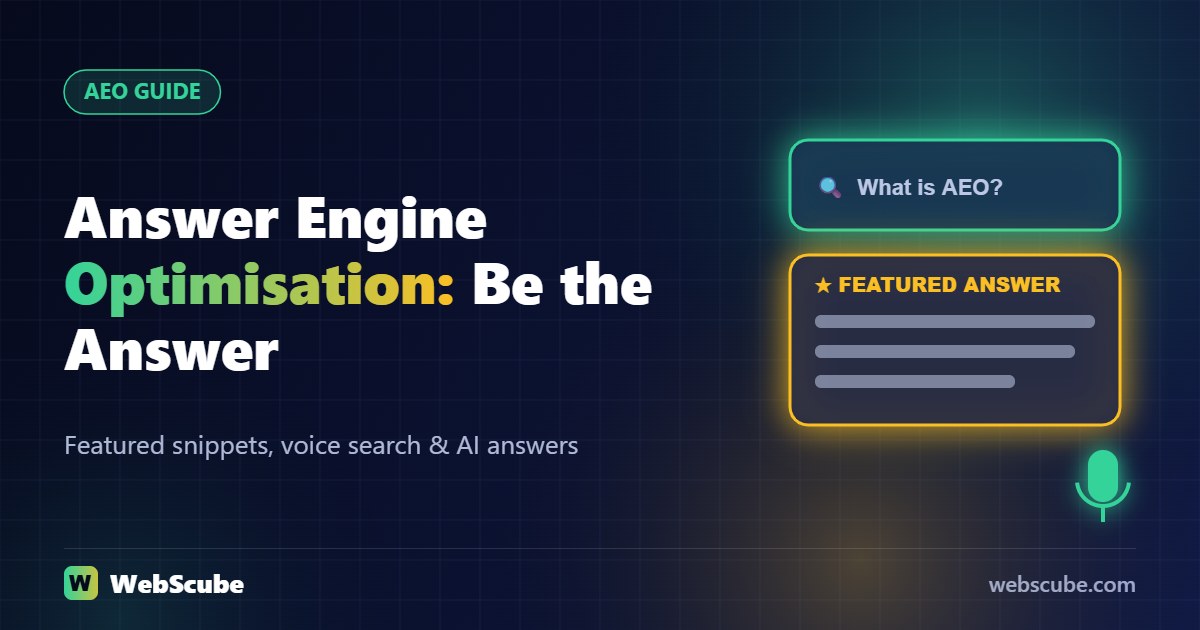
Quick answer: Answer engine optimisation (AEO) is the practice of structuring your website content so that search engines, voice assistants and AI tools can pull it out as a direct answer to a user’s question. It involves writing clear question-based headings, giving concise 40–60 word answers right below them, using lists and tables, and adding schema markup such as FAQPage and HowTo so machines understand your content.
More and more searches end without a click. People read the answer box at the top of Google, ask a smart speaker, or get a summary from an AI tool. If your content is the source of that answer, you win visibility, trust and brand recall — even when the user never visits a list of results.
Where do “answers” appear?
- Featured snippets – the highlighted box at the top of Google results.
- People also ask (PAA) – expandable questions related to the search.
- Knowledge panels and local packs – business information, maps and reviews.
- Voice assistants – Google Assistant, Siri and Alexa reading out one answer.
- AI Overviews and chat assistants – summaries that cite source pages.
Step 1: Find the questions your customers ask
AEO starts with questions, not keywords. Collect them from:
- Google’s “People also ask” boxes and autocomplete suggestions.
- Questions customers ask you on calls, WhatsApp and email.
- Google Search Console queries containing what, how, why, which, best, cost.
- Forums such as Quora and Reddit, and free tools like AnswerThePublic.
Group the questions by topic. Each group can become one blog post or one FAQ section on a service page.
Step 2: Use the “question → answer → detail” format
For every important question on a page:
- Use the question (or a close version) as an H2 or H3 heading.
- Immediately answer it in 40–60 words, in plain language, without a sales pitch.
- Then expand with examples, steps, data and nuance.
This “inverted pyramid” gives answer engines a tidy block to extract, and gives human readers the answer they came for straight away.
Step 3: Match the format to the question
| Question type | Best format | Example |
|---|---|---|
| What is / why | Short paragraph definition | What is local SEO? |
| How to | Numbered steps | How to verify a Google Business Profile |
| Best / types / ideas | Bulleted list | Best website features for a clinic |
| Compare / vs / cost | Table | Shared vs cloud hosting cost |
Step 4: Add structured data
Schema markup removes guesswork for search engines. The most useful types for AEO are:
- FAQPage – for question-and-answer sections.
- HowTo – for step-by-step guides.
- Article / BlogPosting – with author, publish date and updated date.
- LocalBusiness – for address, hours, phone and reviews.
WordPress plugins such as Rank Math or Yoast SEO make adding most of this straightforward. Always test your markup with Google’s Rich Results Test.
Step 5: Optimise for voice and conversational search
Voice queries are longer and more natural: “Which is the best SEO company near me that also builds websites?” To capture them:
- Write in a natural, conversational tone.
- Include location phrases your customers use (“in Ahmedabad”, “near SG Highway”).
- Keep answers short enough to be read aloud.
- Keep your Google Business Profile complete and accurate — many local voice answers come from it.
Step 6: Build trust signals
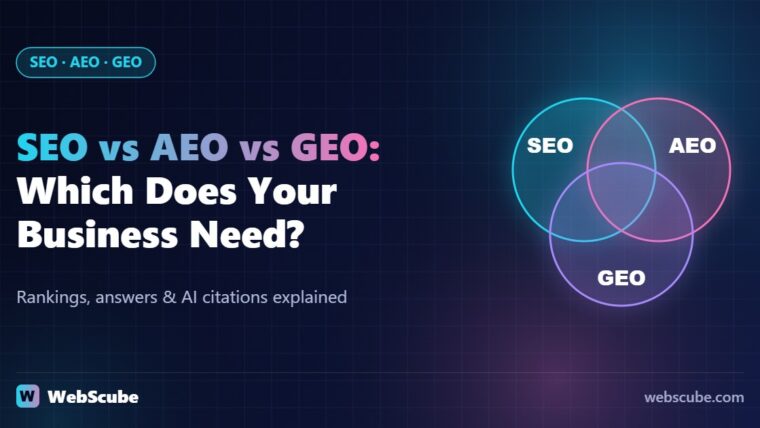
Answer engines prefer sources they trust. Show author names and credentials, cite reliable sources, keep content updated, collect genuine reviews, and make sure your site is fast, secure (HTTPS) and mobile-friendly. Technical health still matters — read our comparison of SEO vs AEO vs GEO to see how they support each other.
Step 7: Track your results
- In Google Search Console, watch impressions and click-through rates for question queries.
- Search your target questions regularly and check who owns the snippet.
- Look for growth in branded searches and direct enquiries.
Common AEO mistakes to avoid
- Burying the answer under long introductions.
- Writing one giant FAQ page instead of answering questions in context.
- Adding FAQ schema for questions that aren’t visible on the page.
- Copying competitors’ answers instead of adding your own experience.
Want your business to be the answer?
WebScube’s answer engine optimisation (AEO) service restructures your key pages, adds the right schema and builds out question-focused content around your services. Pair it with our generative engine optimisation (GEO) work to appear in AI assistants too. WhatsApp us on +91 98988 09847 to get started.
Frequently asked questions
What is the difference between AEO and SEO?
SEO aims to rank your pages in search results so people click through. AEO aims to have your content selected as the direct answer in featured snippets, voice assistants and AI summaries, often without a click.
How long should an answer be to win a featured snippet?
A concise answer of roughly 40 to 60 words placed directly under a question-style heading works well for definition and explanation queries. Use lists or tables for steps and comparisons.
Does FAQ schema still help in 2026?
Google shows FAQ rich results for far fewer sites than it used to, but FAQ schema still helps search engines and AI tools understand your question-and-answer content, so it remains worth adding where the FAQs are visible on the page.
Is AEO only for big websites?
No. Small businesses often win answer boxes for specific local and niche questions because they can answer them more precisely than large generic sites.
Written by Dharmesh Vasani, WebScube Enterprise, Ahmedabad. WebScube builds websites and runs SEO, AEO and GEO campaigns for businesses in India, Singapore and Australia.